
Sample 2
A Sample from The Music Teacher's Playbook
Module 8: Effective Emailing and Phone Calling
The Music Teacher's Playbook is a 17-module program built for private music teachers and studio owners. These are musicians who graduated with strong performance training but no idea how to actually run a business.
It covers the full arc of what that takes: setting rates, recruiting students, handling a tough parent conversation, building studio policies, marketing a program.
Teachers move through pre-recorded video lessons and companion guides at their own pace, then bring what they're stuck on to weekly live coaching calls and an ongoing peer community because reading about how to raise your rates and actually sending that email to twenty current students are two very different things.
Module 8 is an eight-lesson module teaching private music teachers how to recruit students and communicate with confidence without the anxiety.

The audience
Private music teachers and studio owners who experience anxiety around networking, cold outreach, and professional communication, many of whom have had no formal training in relationship-building, persuasive writing, or sales-adjacent communication.
The problem
Music teachers struggle with outreach because they have no clear, repeatable system for contacting potential students, parents, or band directors. They know what they want to say but lack a structured process for saying it across email and phone which leads to avoidance and missed opportunities.
The solution
I designed an eight-lesson module sequenced from psychological readiness to applied skill to system implementation, using an ADDIE-style process: diagnosing the real barrier before choosing a strategy.
The module includes a paired-practice framework adapted from Dale Carnegie's interpersonal communication principles; worked-example email templates built on a UDL (Universal Design for Learning) principle, presenting the same content in two formats for different processing preferences; a procedural Gmail walkthrough for reusable templates and labels; and a scripted phone-call framework culminating in a live, evaluated mock call.
The email templates are intentionally offered in two formats, a paragraph-style version and a scaffolded outline version, reflecting a Universal Design for Learning approach: giving learners more than one way to access the same content rather than assuming a single format works for everyone. Video content is captioned and PDF guides follow accessible formatting practices throughout.
My role
I served as both instructional designer and subject matter expert. I personally designed, scripted, and recorded the bulk of the module, oversaw team members recording additional lessons from my outlines, and edited all video content.
The weekly live coaching calls and discussion forum function as a behavior-level evaluation mechanism (Kirkpatrick Model); rather than only collecting satisfaction feedback, I directly observe whether teachers can implement real changes and coach them through it when they can't.
Outcome
Teachers completing this module reach out to leads with less anxiety and more confidence.
One participant reported that following up on an initial cold email got her "so many more responses" than the first round alone.
Another described moving from feeling "not confident with email communication" to feeling "more confident in communicating with prospective students/parents and local teachers."
Constraints
-
Teachers had no prior structured communication system and often avoided outreach entirely
-
The skill needed to transfer to immediate, real-world use...a real email sent, a real call made
-
Most participants were balancing this alongside running a full private studio
What I Built
Workflow-Based eLearning Content
Eight lessons walking private music teachers through the moments they dread most: reaching out to a new student's family, following up after a missed connection, emailing a band director, making a cold phone call.
Each lesson breaks one of these interactions into a repeatable process, so teachers have a system to lean on instead of improvising.
Below are a few of the actual materials I built for this module.


Communication Frameworks
I created repeatable, step-by-step workflows for common outreach scenarios (email, phone), reducing reliance on instinct.
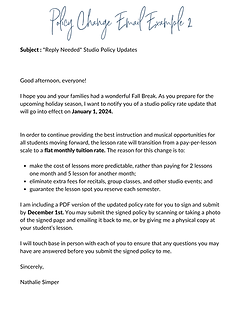
Template Library
I developed reusable email templates in two formats (paragraph and scaffolded outline) so teachers can adapt them to their own voice.

Job Aid (Downloadable Quick Reference Tool)
I wrote the Perfect Phone Call Framework, a one-page reference for real-time use during a call.
Tools
Kajabi (course hosting)
Canva (worksheets, visual design)
Zoom (live coaching calls)
Loom (screen-recorded tutorials)
Envato (stock assets)
AI tools (outline cleanup, scripting)
Want more detail?


